


Quantum Cascade Lasers
Compact, lightweight and robust solid-state lasers for the infrared spectrum. AdTech Photonics develops QCL technology for applications in defense, remote sensing, environmental monitoring and beyond.
QCL Technology
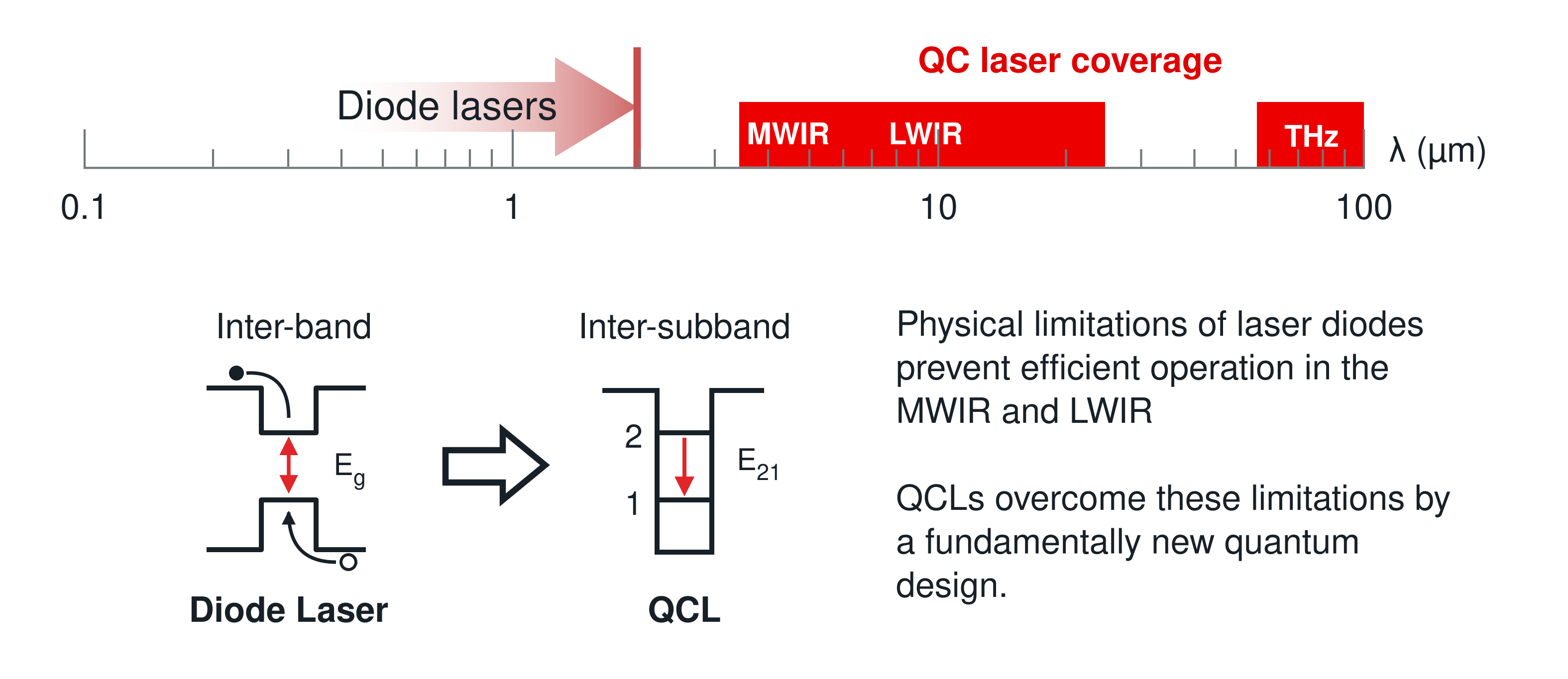
Quantum cascade (QC) lasers use a different technology from traditional semiconductor lasers. They provide the convenience of a solid-state laser at wavelengths previously attainable only through bulky or unreliable systems.
These compact devices have found use in military and remote sensing applications, with further potential across medical, transportation and environmental applications.
01 / Technology
AdTech's Quantum Cascade Lasers
AdTech Photonics has been developing and producing innovative QC lasers since 2005. QCLs, first invented at Bell Labs in 1994, are capable of infrared emission in the mid-wave and long-wave IR spectral range (λ = 3.5–25 µm), and have also been used to generate THz frequencies.
They differ from traditional semiconductor diode lasers in that they do not use a p-n junction for light emission. Multiple active regions are “cascaded” so that each injected electron can emit multiple photons and therefore enhance laser gain.
Each active region is composed of a multilayer semiconductor material structure designed to have an electronic band structure that gives the desired emission wavelength, and is manufactured with nanometer-level thickness control.
AdTech's QCLs are designed to cover most of the mid-infrared spectral range, from 3.8 µm to 12.5 µm, and to achieve high power and high efficiency at specific wavelengths. Almost all of AdTech's QCLs operate continuously at room temperature and can be designed for single-frequency operation using distributed-feedback waveguide fabrication.
02 / Device fabrication
The Device
AdTech's devices are fabricated using the platform technologies available for conventional diode lasers, drawing on decades of semiconductor technology development for telecom/datacom applications.
Our QC lasers are generally built with InP-based materials, widely used in the optoelectronics industry.
AdTech's lasers are edge-emitting devices that can be mounted in packages similar to established telecom/datacom configurations, including C-mounts, CS-mounts, high heat load (HHL), butterfly and TO-can packages.
Explore packaging options →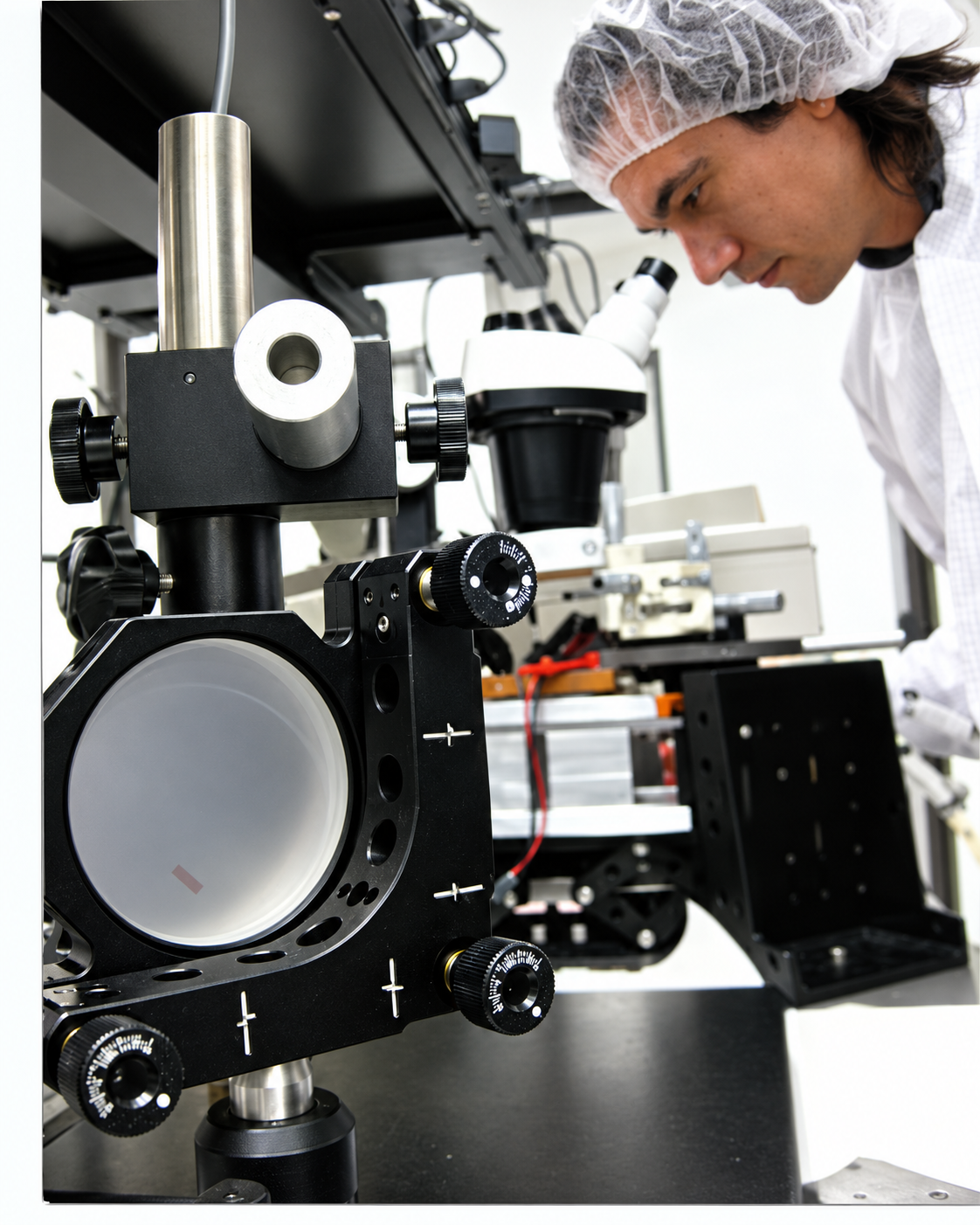
03 / Material growth
MOCVD
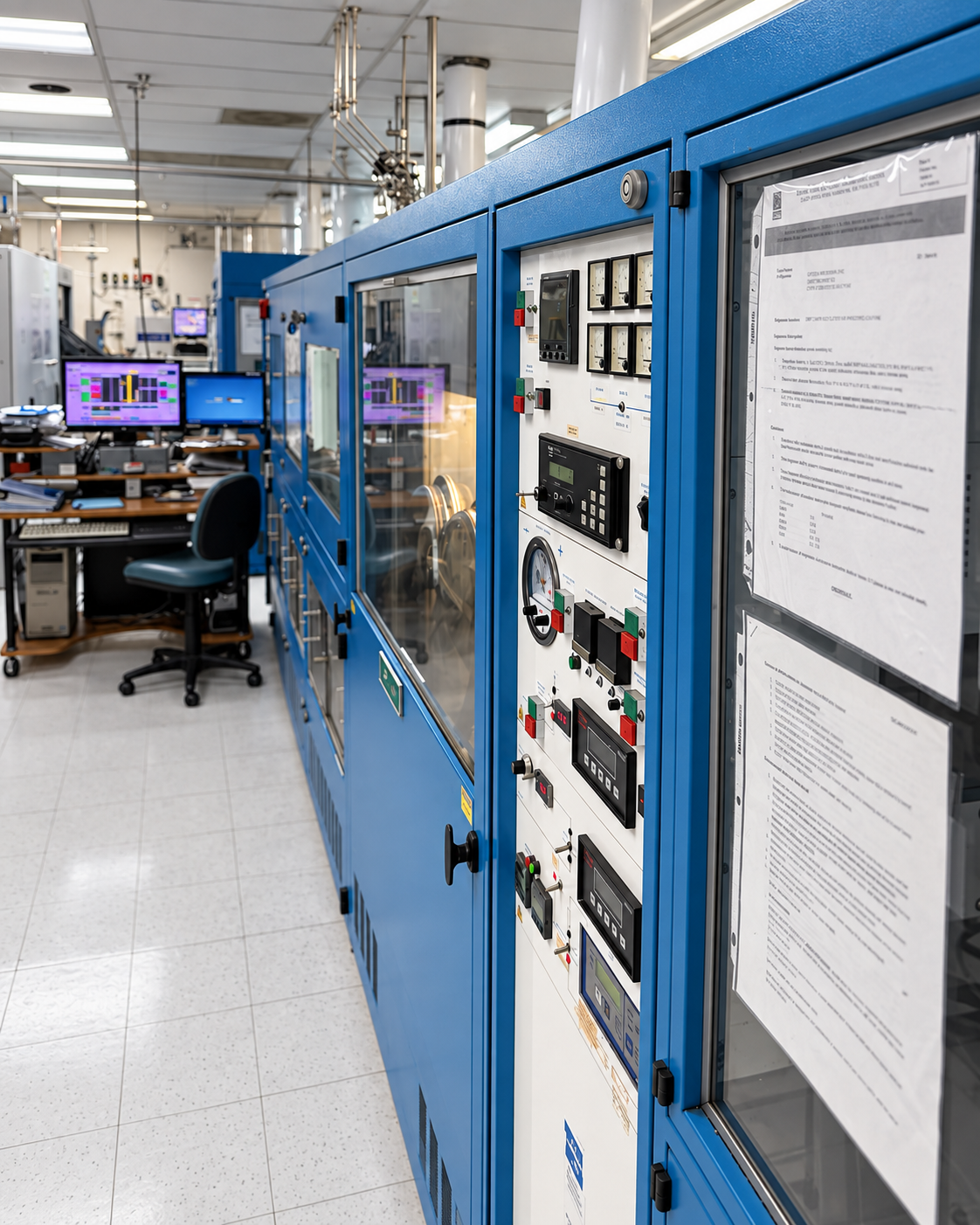
AdTech Photonics has selected MOCVD as the technology of choice for its growth of semiconductor materials.
The advantages over alternative techniques include a high growth rate, the ability to fabricate buried heterostructures for enhanced thermal dissipation, and stability over long runs.
MOCVD is a platform technology that enables industrial volume production of high-quality semiconductor lasers. Our surface quality and wafer uniformity are comparable with the state of the art in the industry.
04 / Technology maturity
Technology Maturity
QCLs are inherently more robust than diode lasers because they are not based on a p-n junction for their operation. AdTech's lasers have demonstrated continuous, stable room-temperature operation over several years.
Our devices are deployed in systems for defense, security, environmental, health and analytical applications. We fully characterize our QCLs before deployment and have proven thousands of hours of operation from our devices.
AdTech Photonics works with customers to find suitable solutions for their application needs.
05 / Molecular sensing
The Mid-Infrared Region
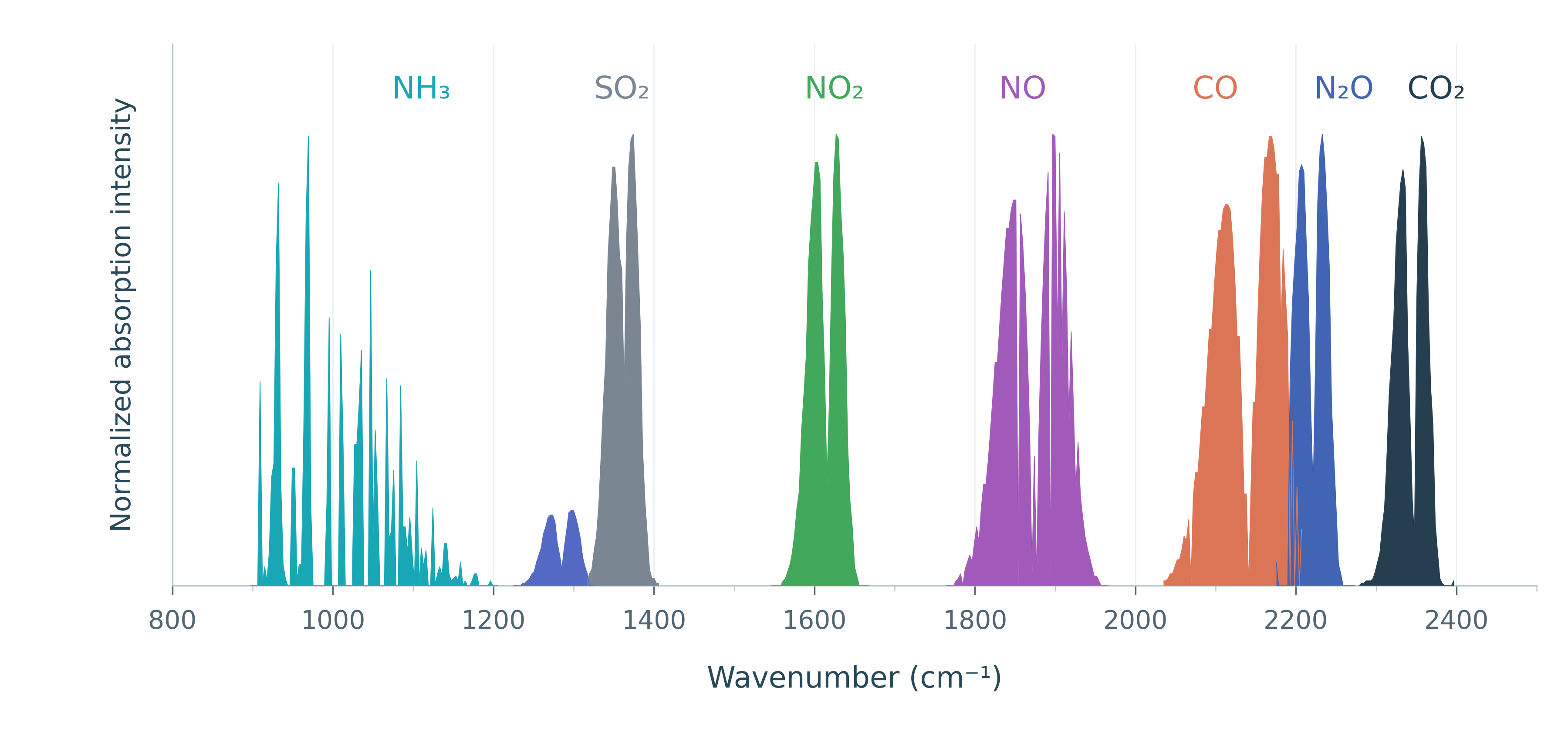
Many important molecules have their strongest absorption resonances in the mid-infrared region of the electromagnetic spectrum. AdTech's QC lasers can be designed for mid-IR wavelengths to help identify chemicals, gases, liquids, contaminants, hazardous materials and pollutants, even in trace quantities.
Operational Requirements
AdTech's QC lasers are operated in the same way as common diode lasers, but require different bias conditions, such as higher voltages. Refer to the specification sheets for details.
View laser specifications →Laser Selection
AdTech Photonics can assist with selecting or designing lasers for your application, drawing on our experience in laser design, growth, fabrication and packaging.
Discuss your application →